FEATURED
Building the Decision Stack
Establishing the data foundation enterprise decisions depend on.
→ Enabled scalable asset management and risk prioritization across 30K+ assets, improving program assignment and operational efficiency
Platform Architecture · Systems of Record · Enterprise Scale
Building Systems That Scale Decisions
The Three Layers of Durable Scale
Complex platforms don’t fail from missing features — they fail from missing structure. I design the systems, data models, and governance that turn enterprise complexity into clear, scalable decisions.
Each case study shows how I build that structure in practice:
Durable foundations
Governed intelligence
Disciplined ecosystem scale
Together, they show how I turn enterprise signals into decisive, scalable outcomes.
Designing Trustworthy AI
Engineering AI systems that increase velocity while preserving trust.
→ Reduced manual triage by 70% across 200+ organizations
AI Governance · Risk Architecture · Privacy Controls · Executive Impact
Scaling a Marketplace Through Governance Systems
Architecting marketplace systems where incentives and execution reinforce each other.
→ Exceeded multi-year NPS target (58 vs. goal of 50) and increased program participation by 27% YoY
Marketplace Strategy · Roadmap Governance · Operational Scale
CASE STUDY 1
FOUNDATION
Building the Decision Stack
Architecting the foundation for enterprise-scale decision velocity.
Platform Architecture · Systems of Record · Enterprise Scale
My Role: Led product strategy and execution to build a canonical system of record, standardize risk prioritization, and enable scalable decision-making.
The Environment
As enterprise security complexity increased—driven by expanding attack surfaces, fragmented tooling, and rising vulnerability volume—decision-making slowed.
Fragmented asset visibility
Increasing signal volume
Manual and inconsistent prioritization
II. Standardization Enables Scale
Risk normalization embedded into core workflows.
The Problem
The challenge wasn’t more data—it was fragmented systems and workflows.
Without a canonical system of record:
Inconsistent, hard-to-compare risk signals
Workflows couldn’t scale across teams
Automation would amplify noise instead of improving outcomes
I. Foundation Before Acceleration
Canonical asset models before automation.
III. Workflow Before AI
Optimized for human cognition before acceleration.
IV. Automation as a Final Layer
AI introduced only once governance and inputs were durable.
→
What I Built
Built a canonical system of record for asset and vulnerability data
Standardized risk normalization (CVSS → VRT mapping)
Scaled asset management and program assignment workflows
Established a clean data foundation for AI and automation
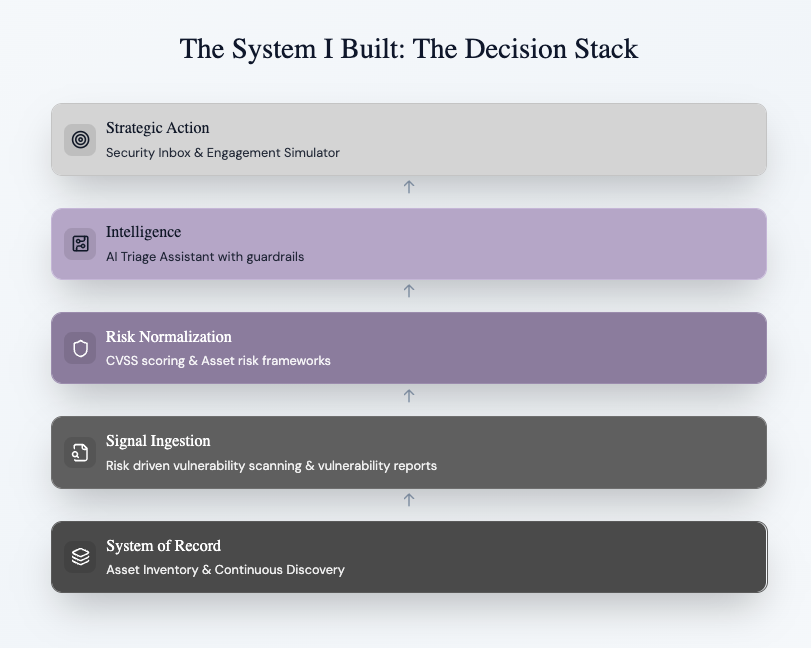
The Architecture
Built in a live system — not a greenfield rebuild.
Data models > feature velocity
Normalize risk before automation
Governance before AI
Long-term scale > short-term speed

IMPACT
Enabled continuous visibility across 30K+ enterprise assets
Reduced manual prioritization through automated risk normalization
Scaled program workflows and asset assignment across enterprise customers
The Tradeoffs
CASE STUDY 2
AUTOMATIONS
Designing Trustworthy AI
From Signal to Trusted Remediation Velocity
Designing human-in-the-loop AI to improve triage speed without compromising trust.
AI Governance · Risk Architecture · Privacy Controls · Executive Impact
The Challenge
AI can accelerate prioritization—but without governance, it increases risk.
High vulnerability volume
Manual triage bottlenecks
Inconsistent severity decisions
High sensitivity to enterprise risk
We needed trusted automation—not faster noise.
AI Architecture
I. Standardize Before Acceleration
Embedded CVSS → VRT mapping before introducing AI
II. Centralized LLM Governance
Centralized controls and governance guardrails
Tradeoffs We Made
> Scoped AI to assistive triage (not full automation)
> Embedded privacy and governance from day one
> Sequenced rollout after control frameworks were validated
What I Built
> Led productization of AI Triage Assistant from early capability to enterprise-ready product
> Embedded AI into triage workflows for contextual, in-platform decision-making
> Established governance, privacy, and LLM control frameworks for safe enterprise adoption
> Owned GTM rollout and drove adoption across enterprise customers
> Delivered continuous improvements through post-launch iteration and enhancements
AI was introduced only after establishing structured data, governance, and workflow integrity.
III. Privacy by Default
Privacy-first architecture built into the core platform
IV. Executive-Linked Outcomes
Modeled ROI to secure executive alignment and sustained investment
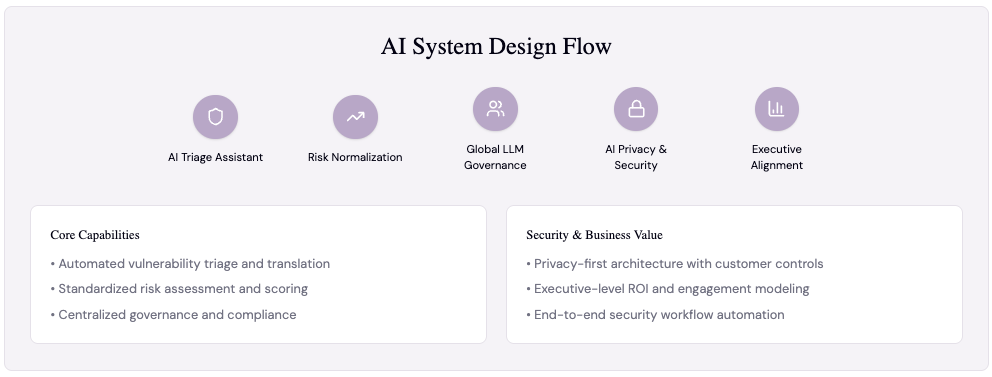
Enterprise Impact
Delivered measurable operational leverage at enterprise scale:
> 70% manual triage workload reduction
> 200+ AI-augmented organizations
> 20% → 27% week-over-week adoption increase during phased rollout
Published Materials & Thought Leadership
> Turn vulnerability data into remediation velocity: Introducing Bugcrowd AI Triage Assistant
CASE STUDY 3
MARKETPLACES
Scaling a Marketplace Through Governance Systems
Scaling a multi-sided security marketplace through structured systems—not feature sprawl.
Marketplace Strategy · Roadmap Governance · Operational Scale
What I Built
Built governance and operational systems to scale a two-sided marketplace of 30K+ researchers and enterprise customers
Designed roadmap governance (intake, business cases, prioritization) to align investments to platform strategy
Launched incentive programs (P1 Warriors, Bounty Slayers, MVP) to drive participation and signal quality
Led global rollout of Support & Customer Success platform (Freshdesk Omni), redesigning routing, SLAs, and escalation workflows
Improved platform usability to reduce friction in program and engagement management
The Problem
As the marketplace scaled, complexity increased across both sides:
Competing enterprise, researcher, and internal priorities
Limited visibility into marketplace performance and workflows
Strained support, escalation, and triage systems
Inconsistent customer and researcher experience
Roadmap capacity constraints
Design Principles
Standardized workflows before scaling
Prioritized platform integrity over customization
Balanced enterprise needs with marketplace equity
Invested in internal systems to reduce downstream friction
Used data to drive prioritization and operational decisions
27% YoY increase in submission volume
Launched incentive systems to drive participation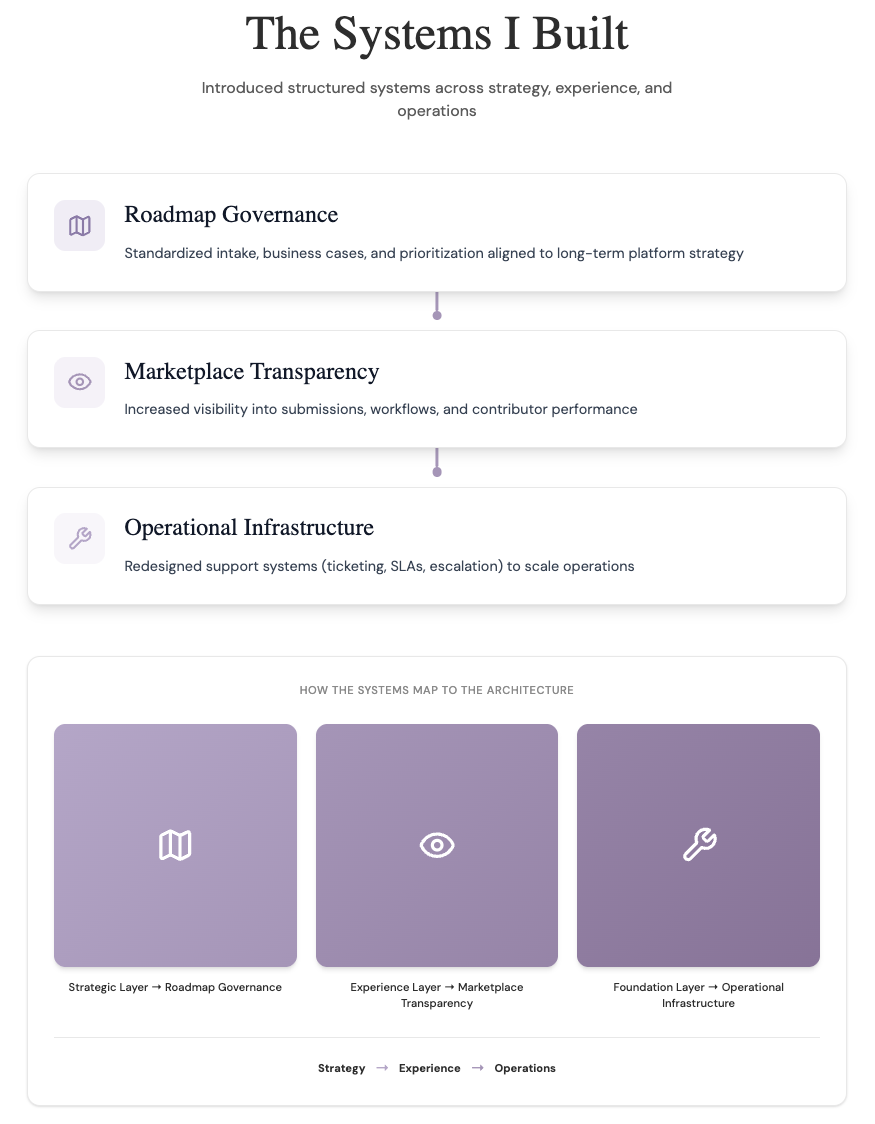
To scale the marketplace, I introduced structured systems across roadmap, experience, and operations.
Impact
These systems transformed the marketplace from reactive operations into a scalable, data-driven platform.
25% annual growth in qualified researcher pool
Expanded and retained high-quality contributorsReduced backlog from 10,000+ → 600 tickets
Accelerated triage and improved marketplace liquidityImproved customer experience (NPS 50 → 58)
Delivered through workflow, UI, and operational improvements